How to Map a Fae Realm for Your Romantasy Novel
You have the courts in your head, a heroine on the wrong side of the border, and a fae love interest who should not be anywhere near her. What you probably do not have yet is a map, and around chapter ten that starts to cost you: the journey to the other court takes three days in one scene and an afternoon in the next, nobody remembers which side of the river the mortal village sits on, and the place where everything falls apart has no fixed address. A fae realm map is not decoration. In a romantasy, the borders decide who can be with whom, and the distances decide how long two people are stuck together on the road. Here is how to build one that serves the love story, step by step, with a checklist to copy.
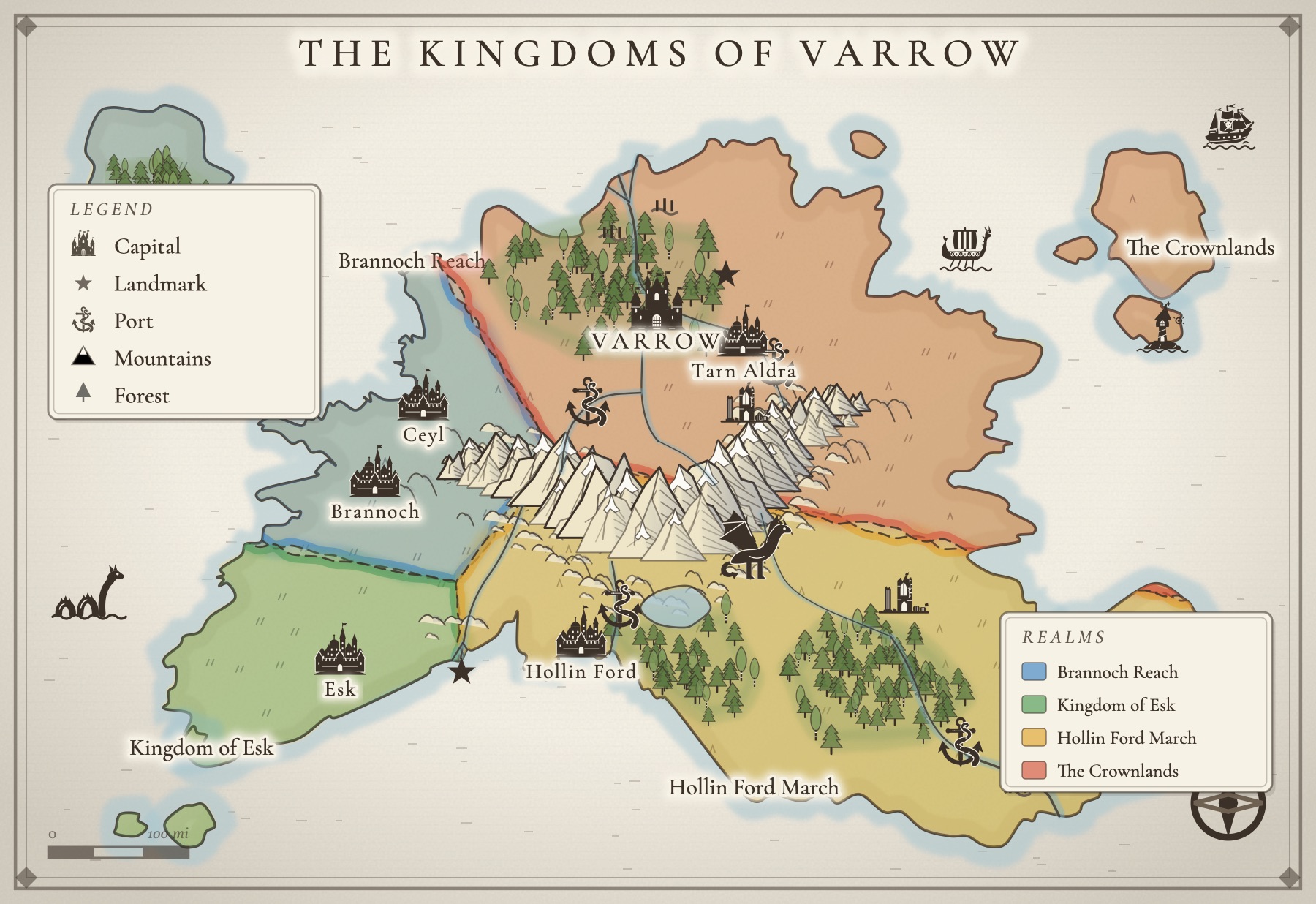
Map early, but only as much as the story needs
There are two failure modes, and romantasy writers fall into both. The first is drafting with no map at all, so the geography quietly contradicts itself. Christopher Paolini told Writer's Digest that he only realized he needed a map about a third of the way through Eragon, once the story left its first small town and he could no longer keep travel times and distances straight in his head. The second failure mode is the opposite: spending six weeks on a continent, eleven courts and a river system before writing a single scene between your two leads.
The fix is a working map that grows with the draft. The Book Designer's guide to fantasy world maps separates the map you make for your own reference, where function beats form, from the one that goes in the printed book, and suggests waiting until the final draft for the second. That is the right order. Sketch the courts, the crossing and the main route before you start, then add each new place the first time a scene goes there.
IngramSpark's world-building tips for romantasy make two points worth keeping beside the map. In romantasy the relationship is central, and the world should press on it, for better or worse. And you should keep a log of your world's rules and details so the book stays consistent. A map with notes on it is that log, laid out where you can see it.
Courts as realms: borders that mean something
In most fantasy, a border is where one king's taxes stop and another's begin. In a fae romantasy, a border should change something about the person who crosses it. That is what makes it worth drawing. For every border on your map, answer three questions:
- Who can cross? Anyone, only fae, only those invited, only at a certain season, only by paying something. A border your heroine cannot cross alone forces her to need someone.
- What changes at the line? Magic stronger or weaker, time running faster or slower, a law that applies on one side only, a vow that binds only inside. Something your characters can feel the moment they step over.
- What does it mean for the romance? A border can be where they are allowed to be together and where they are not. It can be the line one of them has sworn never to cross. It can be where a bargain becomes due.
Draw each court as a realm with its own colour, so you can see at a glance whose land a scene is in. Then write the answers on the map, not in a separate document. Our guide to designing fae courts goes deeper on what each court values, how it rules and what it wants, and that is the material your borders are made of.
The mortal and fae divide
Most fae stories have a line between the human world and the other one, and the shape of that line decides what kind of crossings your plot gets. Folklore offers plenty of models. In Irish tradition the fair folk withdrew into the sídhe, the old burial mounds, and the Wikipedia entry on fairies collects tales where time runs differently on the other side: Thomas the Rhymer spends seven years in Elfland, and Oisín returns to find centuries have passed. The same entry notes cold iron as a charm against fairies and the danger of eating food in Fairyland. Any of these can become a rule of your map. Here are the common shapes of the divide and what each one does to a story:
- A wall. Built, guarded, political. Crossings are rare and someone always knows. Good for a story about a treaty, a war or a smuggler.
- A veil. Invisible, thin in places, thinner at certain times. Good for accidental crossings and for a heroine who does not know she has stepped through until it is too late.
- A forest. Wide, slow and dangerous to cross, with no clear line where one world ends. Good for a journey, and for getting lost together.
- The sea or a river. A crossing that needs a boat, a bridge or a price. Good when you want the way back to be expensive, or impossible for half the year.
- A door or a mound. One fixed place. Good for a story that keeps returning to the same threshold, and for a scene where someone waits on the wrong side of it.
Whichever you choose, mark the crossing points as places of their own and write on each one how it works. Where the divide sits relative to your heroine's home matters too. A border a morning's walk away means she can go back. A border three weeks away means every choice to leave is a choice to stay gone.
A landscape for each court
Fae courts are often given a season or an element each, and readers of the big bestsellers know that shape well. You do not have to use it. A stronger approach is to let the land grow out of what the court values and what it is afraid of. A court that trades in bargains might sit on tidal marshes, where the path you walked in on is underwater by evening. A court ruled by oaths might keep to snowfields, where every footprint shows who came and went. A court that hoards beauty and hates change might live among dunes that bury anything left still for long.
Two rules keep this from becoming scenery. First, the landscape should make some scenes possible and others impossible: you cannot sneak across a snowfield, and you cannot hold a secret meeting in a marsh at high tide. Second, at least one romantic scene in each court should depend on its land. A shelter from a storm. A crossing that needs two people. A view from the only high ground for a day's ride. Our guide to realistic fantasy map geography covers where rain, rivers and mountains fall if you want the landscapes to sit together believably.
Distances, travel time and the road
A romance needs time alone together, and a journey is the oldest way to get it. Forced proximity on the road works because the distance is real: they cannot simply leave, and there is only so much ground to cover before they arrive and the world comes back. That makes travel time a romance decision, not a logistics one.
- Decide your speeds once. How far a day on foot, on horseback, by boat. Write them on the map.
- Size the journey to the arc. If the road needs to carry their first real conversation, a fight, a night with one fire and a near confession, that is four or five stops, so make it four or five days.
- Put a cost on magical travel. If fae can step across the realm in a heartbeat, the road disappears and so does your forced proximity. Limit it: it only works inside one court, it drains the traveller, it cannot carry a mortal, it leaves a trace.
- Mark the stops. The inn with one room left, the ruin they shelter in, the river they have to ford. Each is a place on the map and a scene in the book.
If you are building a slow burn, the road is where much of it happens. Our guide to writing a slow burn romance covers pacing the tension, and tracking a novel's timeline keeps the days honest.
Places that carry the romance
Every love story has a handful of places that do more work than the rest. Find yours early and put them on the map with a note of the chapter where each one matters. Most romantasies have some version of these:
- Where they meet. Often on a border, or somewhere neither of them should be.
- The place they cannot go. A court that would kill one of them, a temple where the vow was made, home.
- Where they first let their guard down. Usually somewhere quiet and away from the court: a ruin, a roof, a shore.
- Where the betrayal happens. Ideally a place the reader has already seen as safe, so the setting turns with the story.
- Where it all comes back. The final choice is stronger in a place the book has visited before. Mirror the first meeting if you can.
When these places are on the map, you can see whether the romance is spread across the world or crammed into one corner, and whether the journey between them makes sense. If you are choosing the beats themselves, our guide to romantasy tropes helps you pick the ones that fit your couple.
Secret places and spoilers
A fae map is full of secrets: the hidden court nobody admits exists, the true location of the thing everyone is hunting, the place one of your leads was really born. Your working map should hold all of them. The map you show beta readers, a critique group or, later, readers of the book should not. Make two copies from the same map: yours with everything, and theirs with the spoilers left off. That way their reaction to the reveal is a reaction to your writing, not to a label they spotted in chapter one.
The city or palace map
Plenty of romantasies spend half the book inside one court's capital or one palace. If that is your story, the world map matters less than the street plan: how far the market is from the gates, which bridge leads to the temple, how long it takes to cross the city at night. Make a second map for the capital and link it to the world map so you can move between them. Our guide to making a city map walks through streets and districts.
For the palace itself, think in rooms. Whose chambers are next to whose, which corridor has no guard after midnight, where the garden door lets out. Those distances decide who can overhear what and who can visit whom unseen, and in a romance that is half the plot. A floor plan sketched on paper, or a few lines in your notes, is enough.
Step by step in Inkling's map maker
Here is the same process in Inkling's map maker, using only what it does today. (For a running start, the free fae court maker opens a seven-court fae realm with your own court already named on it.)
- Start the land. Pick a ready-made layout or draw your own coastline. Do not worry about the edges of the world yet. Draw the part the story uses.
- Carve the courts. Use Realms to divide the land into courts. Each realm gets a soft colour and a dashed border, and a key in the corner lists them all. Realms never overlap, so a border is always a clear line. Name each one.
- Draw the divide. If the mortal lands sit on the same map, make them a realm of their own. Use the sea, a river or a narrow realm as the crossing, depending on the divide you chose.
- Fix the borders as the draft changes them. Redraw part of a border by drawing a new line, or split a realm in two when a court divides or a rebel territory breaks away.
- Give each court its land. Paint dunes, marsh or snowfields where they belong. Stamp castles, towns, temples, ruins and taverns, and add a dragon or a sea serpent if your world has them.
- Lay the roads. Roads find their own way between towns, which gives you a quick sense of how a journey bends around mountains and water.
- Write on the places. Select a place and write private notes on it: the chapter it matters in, who is there, the rule that applies inside. These notes are never drawn on the map or exported.
- Hide your secrets. Tick Secret on the hidden court or the twist location. The Download menu then offers a Spoiler-free copy without those places, for beta readers.
- Open the capital. Double-click a town to open its own linked city map. This needs a Map Pass or Plus.
- Start the book from the map. On a kept map, Write a story here starts a story named after the map, with its places listed in the notes, so the draft and the world begin together.
If you want the map to look like it belongs in a fae book, the Gilded Night style draws it on ink-blue paper with gold leaf. It is a Map Pass style. For names, the fantasy name generator has tabs for kingdoms and realms, towns and villages, characters and taverns. It has no fae-specific tab, so treat its results as raw material and bend them toward the sound of your courts.
A copyable fae realm map checklist
Copy this into your notes and fill it in before you draw, then keep it beside the map while you draft.
FAE REALM MAP CHECKLIST

THE DIVIDE
[ ] What separates the mortal world from the fae lands? (wall, veil, forest, sea, door)
[ ] Where are the crossing points? How many?
[ ] Who can cross, and what does it cost?
[ ] What changes on the other side? (time, magic, law, food, iron, vows)
[ ] How far is the crossing from the heroine's home?

THE COURTS (one block per court)
Court name:
[ ] What it values / what it fears:
[ ] Landscape (and why it fits those values):
[ ] Who can enter, and on what terms:
[ ] What changes at its border:
[ ] One romantic scene that depends on this land:
[ ] Capital or seat of power (needs a city map? y/n):

DISTANCE AND TRAVEL
[ ] Day's travel on foot / horse / boat:
[ ] Magical travel: how it works, its limit, its cost:
[ ] The main journey: start, end, number of days:
[ ] Stops on the road (inn, ruin, ford, camp):

PLACES THAT CARRY THE ROMANCE
[ ] Where they meet:
[ ] The place they cannot go:
[ ] Where they first let their guard down:
[ ] Where the betrayal happens:
[ ] Where the final choice happens:

SECRETS
[ ] Places to hide on the beta reader copy:
[ ] What each secret place really is (private note):

CHECK AFTER EACH ACT
[ ] Every place named in the draft is on the map
[ ] Every journey matches the travel speeds above
[ ] No border rule broken without a reason on the page
Where Inkling fits, honestly
Inkling is a writing desk with a map maker built in, so the fae realm sits beside the story it belongs to. The Realms tools give you courts with colour, dashed borders and a key, and you can redraw, split and rename them as the book changes. Private notes on each place hold your border rules and chapter references. Secret places and the Spoiler-free copy handle beta readers. Write a story here turns a kept map into a story with its places already in the notes. If you want Inkling to check your draft against the map, Places in your story reads the draft for named places when you press the button. It uses the generator, which you can switch off in Setup.
What it does not do: it does not draw palace floor plans, it has no fae name generator, and it will not tell you whether your travel times add up. That part is still you, a rule written once and a map you check. It also will not invent your courts for you, and that is the point. The best fae realm is the one that only your story could have.
What is free and what is not: during the 14-day free trial you can keep 2 maps and download 2 pictures, which carry a small Inkling credit. Notes, secret places, the Spoiler-free copy (it counts as one of those downloads) and Places in your story all work on those trial maps. After the trial your maps are safe and view-only, and a Map Pass gets you building again. A Map Pass ($29 a year or $4 a month) or a paid Plus subscription ($9 a month) keeps every map, removes the credit, opens linked city maps and includes the Gilded Night style. Write a story here starts a real story, so during the trial it counts toward the 3 stories you can start. The trial itself is 14 days to experience the full writing desk, build worlds, and be creative. No card to start. Pricing has every plan in one place.
If you are just starting your fae story, our hub on how to write romantasy covers the whole book, and a map for your novel covers keeping any map and manuscript in step.
Inkling is an independent writing app. A Court of Thorns and Roses and its sequels are works by Sarah J. Maas, published by Bloomsbury. Inkling is not affiliated with, endorsed by, or sponsored by Sarah J. Maas or Bloomsbury.
A few questions, answered
How do I make a map of a fae realm for my book?
Start with the borders, not the coastline: decide how many courts there are, where the mortal world ends, and what happens to someone who crosses each line. Then add only the places your scenes visit, the routes between them, and a rough travel time for each route. Keep notes on what happens where. A rough working map you check while drafting is worth more than a beautiful one you never open.
How many courts should a fae realm have?
As many as your plot actually visits or fears, and usually fewer than you think. Two or three courts that matter to the romance, plus one the characters only hear about, gives you politics without drowning the reader in names. You can always add a court in book two. It is much harder to make a reader care about seven at once.
Should the mortal world be on the same map as the fae lands?
Usually yes, at least on your working map, because the crossing between them is one of the most important places in the book. Showing both on one sheet makes you decide how far the border is from home, which decides how often your heroine can go back and how much it costs her. A printed map for readers can show only the fae side if the mortal world barely appears.
How do I keep travel times consistent in a fantasy romance?
Decide how far people travel in a day on foot, on horseback and by any magical means, write it down once, and measure every journey on the map against it. If magic can carry someone across the realm in a moment, give it a cost or a limit, or the long journey that throws your couple together stops making sense.
Can I base my map on the one in A Court of Thorns and Roses?
Build your own instead. Readers know that map well, and a world that echoes it will read as borrowed. The useful lesson is the principle underneath: borders that change what a character can do. Start from your own couple and what keeps them apart, and draw the land that makes that obstacle real.
All of it. In one place.
This isn't five apps stitched together. Your storyboard, your cast, your maps, your covers, and the story itself all live on one desk, right beside the words. Nothing to sync between tools. No five separate subscriptions. Just everything a writer needs, finally in the same place.