How to Design Fae Courts for Your Novel (A Writer's Guide)
Search for help designing fae courts and you mostly find reader guides to other people's books and fan wikis that list who rules what. Useful if you want to understand someone else's world, no help at all if you are building your own. This is a writer's guide. It treats a fae court as a working part of a story: a source of rules, politics and danger, a home for one character and a trap for another. You will build a court from five pieces (a philosophy, a hunger, a landscape, a ruler and a rule), see where the old folklore actually comes from, and get a copyable design sheet with one invented court worked all the way through.
Pick a stamp, tap the realm to drop it, drag it into place, double-tap to name it.
What a court is for in your story
Before you decide what a court looks like, decide what it does. In a novel, a fae court usually does four jobs at once:
- Politics. A court is a power structure: a ruler, rivals, alliances, debts. That gives your plot factions to play off each other and a reason for scenes to happen in throne rooms and at banquets instead of in empty forests.
- Rules. A court has laws, etiquette and taboos the characters must learn or break. Rules make danger specific. “The fae are dangerous” is vague; “anyone who eats at this table may never leave” is a scene.
- A home. For at least one character, the court is where they belong, or used to. It holds their family, their obligations, and the version of themselves they are trying to escape or become.
- A threat. For another character, often your mortal, the court is a trap: beautiful, seductive, and very hard to leave.
The richest courts do all four for different people at the same time. The court your love interest calls home is the one your heroine must survive. That tension is half of what makes romantasy work. Our guide to writing romantasy covers the bigger picture, and how to create a fantasy world covers worldbuilding in general.
Build a court from five pieces
A court that is just a season or a colour scheme feels like a theme park. A court built from a set of connected ideas feels like a culture. Start with these five, in this order, because each one shapes the next:
- A philosophy. What does this court believe about the world? “Beauty is the only truth.” “Every gift is a debt.” “Nothing should ever end.” One sentence. This is the court’s spine, and everything else should follow from it.
- A hunger. What does this court want that it cannot make for itself? Mortal music, mortal years, mortal children, mortal grief, a particular kind of dream. The hunger is what brings the court into contact with humans, and so into your plot.
- A landscape. Where is it, and how does the land express the philosophy? A court that believes nothing should end might live in a forest where nothing rots and nothing grows. The landscape is also what you will map.
- A ruler. Who holds power, how did they get it, and what are they afraid of losing? A ruler is a character, not a title, and their fear is a plot engine.
- A rule. One law of the court that a mortal could break by accident in their first hour. Not “be polite” but something specific and strange: no one may say a number aloud; every guest must give a gift before they are given a name; nothing may be refused three times.
With those five pieces you have enough to write chapter one. Everything else (history, architecture, clothing, holidays) can be discovered as the draft needs it.
Seasonal courts and where the folklore comes from
Much of modern fae fiction draws on a pair of terms from Scottish folklore: the Seelie and the Unseelie. Seelie is a Scots word meaning happy, lucky or blessed, from the same root as the English word “silly”, and the Seelie folk were the fairies more likely to repay kindness, though they could still be dangerous if offended. The Unseelie were the hostile ones. The Wikipedia entry on the Seelie summarizes the sources well: the “seely court” turns up in the Scottish ballad “Allison Gross”, recorded around 1783, the folklorist Katharine Briggs described the Seelie and their opposites, and the phrase “Unseelie Court” appears in an 1819 Edinburgh Magazine article on good and bad fairies. Note that the terms are Scottish. Irish tradition uses different ones.
In Ireland, W. B. Yeats’s 1888 collection Fairy and Folk Tales of the Irish Peasantry divides fairies into trooping fairies, who live and travel together, and solitary ones. Yeats records that the fairies were called the daoine sidhe (fairy people), linked by some to the Tuatha Dé Danann, the old gods of Ireland, and that people avoided speaking of them directly, calling them “the gentry” or the daoine maithe, the good people. He also lists three great fairy festivals: May Eve, Midsummer Eve and November Eve. That is where the seasons enter the lore: as the times of year when the fairies are most active, not as separate kingdoms.
Modern fantasy took those ideas and built political maps out of them: a kindly court and a cruel one, or a court for each season. Sarah J. Maas’s A Court of Thorns and Roses series popularized a land of seven courts, four seasonal plus Dawn, Day and Night. Seasonal courts are a perfectly good choice if you make them your own, but they are now familiar territory. Readers who have met a Summer Court before will bring expectations with them. If you use the seasons, give each one a philosophy and a hunger that are yours, not just a weather pattern.
Courts of your own invention
The five-piece method works with any organizing idea, and the less expected the idea, the more your world will feel like nobody else’s. A few directions beyond the seasons:
- Tides. A court of the ebb and a court of the flood, whose power rises and falls twice a day. Their bargains expire with the tide. Their borders move.
- Hours. A court for each hour of the night, each with its own etiquette, so a mortal who stays too long at the wrong hour is under a different law than the one they arrived under.
- Metals. If iron burns your fae, what about the other metals? A court of quicksilver that cannot hold a shape, a court of copper that hungers for the green of age, a court of gold that hoards and fears tarnish.
- Crafts. A court of weavers whose bargains are literally woven, so a contract can be unpicked. A court of glassmakers, beautiful and brittle. A court of bookbinders who collect true names.
- Senses or emotions. A court that feeds on mortal grief, one that feeds on laughter, one that collects memories. Each hunger brings them into conflict with the others over the same mortals.
Whatever your idea, ask what the court wants from humans. A court that needs nothing from mortals has no reason to appear in a story about one.
The rules fae live by (and where each one comes from)
Rules are the most useful thing folklore gives a writer, because each one is a ready-made plot device. Here are the big ones, with what the older sources actually say, so you can decide how closely to follow them:
- Iron. This is one of the most consistent beliefs. The Scottish minister Robert Kirk, writing in 1691 in The Secret Commonwealth of Elves, Fauns and Fairies, recorded that people put bread or a piece of iron in the beds of women in childbirth to keep them from being taken, and that these beings were terrified by nothing earthly so much as “cold Iron”. In your book, decide what iron does: burns, binds, weakens, or simply makes the fae unable to lie or hide. Then decide what it costs a mortal to carry it into a court that can smell it.
- Names. The folklore rule is mostly about not naming the fae at all. W. Y. Evans-Wentz, in his 1911 study The Fairy-Faith in Celtic Countries, calls the taboo against naming the fairies the chief of their taboos, and explains it as a belief that a name and the power it names are nearly the same thing. That is the bridge to the modern rule, where knowing a fae’s true name gives you power over them. Both versions are useful: euphemisms for how mortals speak, true names for what fae guard.
- Food. Evans-Wentz also describes the food taboo: whoever eats the food of fairyland may not be able to return to the world of the living. It gives you an instant test of hospitality. Every banquet becomes a scene with a cost.
- Bargains and service. In the Scottish ballad of Thomas the Rhymer, retold by the National Library of Scotland, a kiss binds Thomas to serve the fairy queen for seven years, and he is not allowed to speak in Elfland or he will never return home. That is a bargain with a term, a condition and a penalty, which is exactly how a good fae bargain in fiction works. Write your bargains with all three.
- No lying. This one is mostly modern. We did not find it as a general rule in the older collections, and fairy tales are full of fairies tricking mortals. Holly Black made it a central rule of her Folk of the Air books, and she says so plainly in a Goodreads piece on faeries. Folklore has the reverse: in the same Thomas the Rhymer ballad, the queen gives him the gift of always speaking the truth. If your fae cannot lie, the drama lives in the loopholes: half-truths, careful wording, and the mortal’s terrible freedom to lie.
Pick the rules you need, decide exactly what each one covers, and write them down. A rule the reader learns in chapter three and you forget in chapter twenty is the kind of continuity slip that fae readers notice.
How courts relate: alliances, tithes and borders
One court is a setting. Two courts are a plot. Define how they relate along three lines:
- Alliances and grudges. Who owes whom, who married whom, and who has not forgiven a betrayal from three hundred years ago. Fae live long; their grudges should too.
- Tithes. Folklore gives you a dark and useful one. In the ballad of Tam Lin, as the National Library of Scotland retells it, every seven years the fairy queen must pay a levy to Hell, and the mortal Tam Lin fears he will be the payment. A tithe paid by one court to another, or to something worse, explains why courts that hate each other cannot simply go to war, and why a mortal might suddenly become very valuable.
- Borders. Where does one court’s land end and another’s begin, and what happens when you cross? A border can be a river, a line of standing stones, a change in the light, or an hour of the day. It should be something a character can feel, and something that changes the rules.
How a mortal moves through a court
Your mortal is the reader’s guide, so their path through the court is the reader’s path through your world. Plan four things:
- How they get in. An invitation, a bargain, a debt, a theft, a rescue, a wrong turn at the wrong hour. The way in usually sets the terms for getting out.
- Who vouches for them. A mortal alone at court is prey. A sponsor, guide or captor gives them a reason to survive and someone to be in debt to.
- What they have that the fae do not. The ability to lie, to touch iron, to make something new, to die. A mortal’s weakness in one court can be a weapon in another.
- What it costs to leave. Time that has passed differently outside, a name left behind, a promise that still binds. Leaving should be possible, and expensive.
The seven-court trap
Here is the most common mistake in fae worldbuilding: designing seven courts in loving detail before writing a page, then trying to introduce all of them in chapter one. Readers learn a world through the places the characters actually go. If your heroine spends the first act in one court, that is the court that needs depth. The rivals need a single strong line each: a name, a philosophy, and a reason to fear them. Everything else can wait until the story travels there, and some of it never will.
A good rule: build one court fully, sketch two, and list the rest only if the plot will touch them in this book. If you are planning a series, keep the others in your series reference and let each book open a new door. Our guide to planning a book series covers pacing a world across several books, and our worldbuilding template has room for the rest.
A copyable court design sheet
Copy this into your notes. Fill in the first five lines before anything else.
FAE COURT DESIGN SHEET

THE FIVE PIECES
Name of the court:
Philosophy (one sentence):
Hunger (what it wants from mortals):
Landscape (and how it shows the philosophy):
Ruler (who, how they took power, what they fear losing):
The rule (one law a mortal could break in their first hour):

THE OLD RULES (how this court treats them)
Iron:
Names:
Food and hospitality:
Bargains (term, condition, penalty):
Lying:

RELATIONS
Allies:
Rivals and grudges:
Tithe (who pays what, to whom, how often):
Borders (what marks them, what changes when you cross):

THE MORTAL'S PATH
How a mortal gets in:
Who vouches for them:
What a mortal has that this court lacks:
What it costs to leave:

IN THIS BOOK
Chapters set here:
What the reader must know by the end of chapter one:
What can wait:
Here is one invented court, worked all the way through:
Name of the court: The Court of the Ninth Bell
Philosophy: Everything has its hour, and nothing may happen out of it.
Hunger: Mortal years. The court cannot age, so it cannot change;
  borrowed years let a courtier grow wiser, or simply grow.
Landscape: A drowned city of bell towers in a salt marsh. The tide
  answers the bells, not the moon. At the ninth bell the water rises
  and the lower streets close.
Ruler: The Bellwarden, who rang the first bell and has not slept since.
  Took power by stopping the old queen's clock. Fears: a bell rung
  out of hour, which would mean someone else can command time.
The rule: No one speaks between the ninth bell and the first.
  A mortal who does owes the court an hour of their life per word.

THE OLD RULES
Iron: Iron cannot be rung. An iron bell is a dead bell, so iron
  is a weapon against the towers, not the courtiers.
Names: Courtiers are named for the hour they were born in. To learn
  someone's birth hour is to know their name.
Food and hospitality: Guests eat only at their own hour. Eat at
  another's and you belong to that hour.
Bargains: Always priced in time. Term: until a named bell.
  Condition: spoken aloud before witnesses. Penalty: the years.
Lying: Courtiers can lie, but never about the time.

RELATIONS
Allies: The Ebb Court, whose tide they set.
Rivals and grudges: The Court of Undying Leaves, who believe
  nothing should end and call the bells a butcher's clock.
Tithe: Every hundred years, one mortal life, given to the marsh
  so that the tide keeps answering.
Borders: The edge of the marsh, where the bells can no longer be
  heard. Step past it and your borrowed years come due at once.

THE MORTAL'S PATH
How a mortal gets in: Rows into the marsh after dark to recover
  a drowned brother and hears the bells.
Who vouches for them: A courtier of the second hour who wants
  to grow old.
What a mortal has: Unbounded time to spend, and the ability to
  age. To the court, that is wealth beyond counting.
What it costs to leave: Every hour she spent inside, taken from
  her life outside.

IN THIS BOOK
Chapters set here: 1 to 9, 22 to 30
By the end of chapter one: the rule of silence, and that bargains
  are paid in years
What can wait: the old queen, the tithe, the Court of Undying Leaves
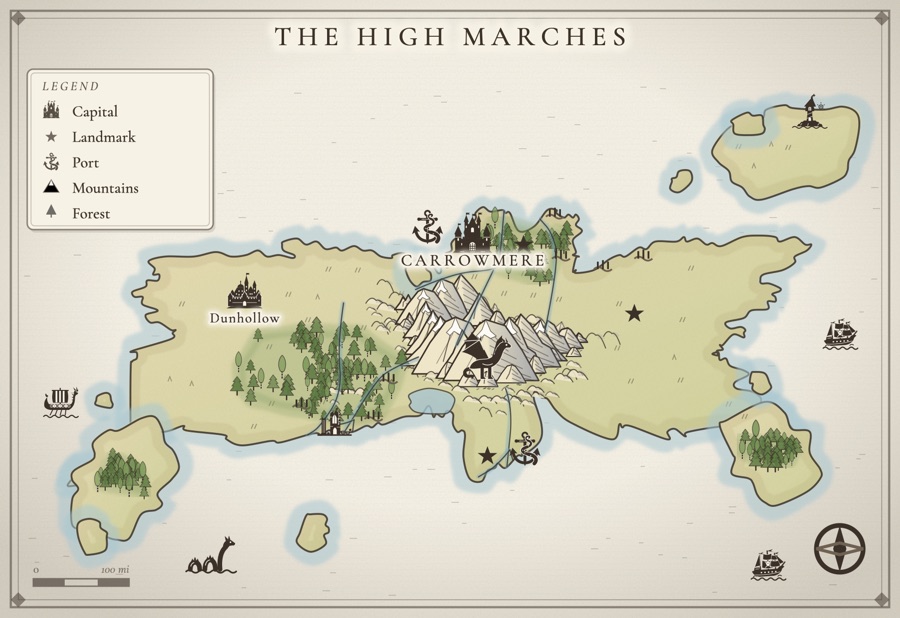
Map the courts as realms
Once you know which courts the story visits, a map keeps their borders, distances and journeys consistent. Draw the courts as territories, mark the borders as the thing a character feels crossing, and put each court’s seat where its philosophy says it should be. Our guide to how to map a fae realm walks through it step by step, and a map for your novel covers keeping a working map in step with a draft. Want a head start? The free fae court maker founds a court from five questions and lights it up on a real fae realm map you can open and build on.
Where Inkling fits, honestly
Inkling does not have a court template, a politics tracker, or a fae name generator. Our fantasy name generator has tabs for towns and villages, kingdoms and realms, characters and taverns, which can help, but nothing fae-specific. The design sheet above is yours to keep by hand. What Inkling does is give your courts a map and keep that map beside the story:
- Realms for the courts. In the map maker, carve the land into realms with a soft colour and a dashed border, redraw part of a border by drawing a new line, split a realm in two, and name each one. A key in the corner lists them all, and realms never overlap.
- Places with private notes. Stamp a castle for each court’s seat, a ruin for the old queen’s clock tower, a temple, a tavern on the border road. Select a place and write private notes on it (the court’s rule, its hunger), which are never drawn or exported.
- A spoiler-free copy. Tick Secret on a place you do not want readers to see yet, and the Download menu offers a Spoiler-free copy without those places.
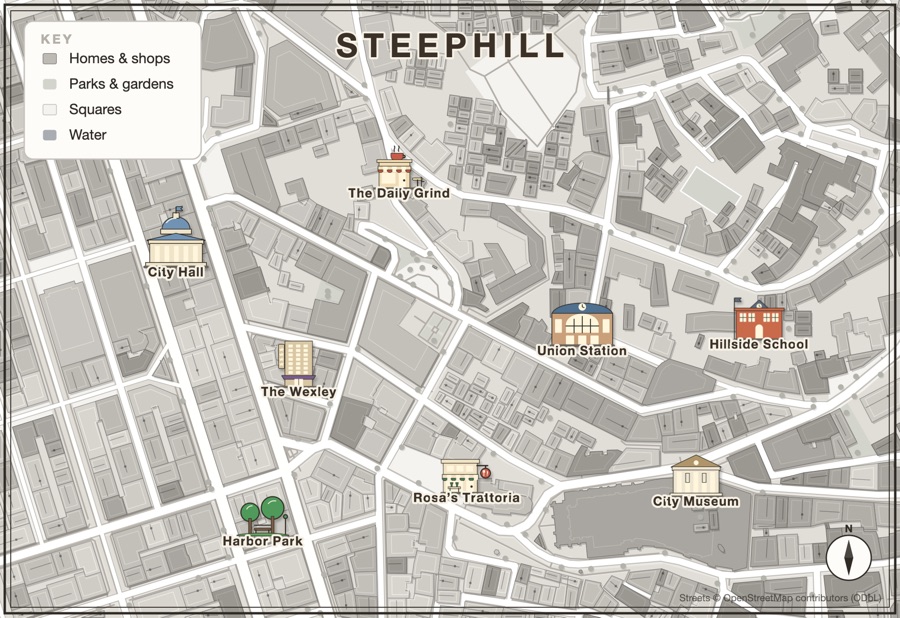
- A city map for the court’s seat. Double-click a town to open its own linked city map. That needs a Map Pass ($29 a year or $4 a month) or Plus. The Gilded Night style, ink-blue paper with gold leaf, is a Map Pass style that suits a court of stars or midnight hours of your own invention.
- From map to manuscript. On a kept map, Write a story here starts a story named after the map, with its places listed in the notes. The Character builder holds each ruler and courtier: want, wound, the lie they believe, and fears.
For the rest of the series, romantasy tropes covers the bargains and rivals your courts will breed, and writing a dual POV romance covers telling the story from inside a court and outside it at once.
Inkling is an independent writing app. A Court of Thorns and Roses and its sequels are works by Sarah J. Maas, published by Bloomsbury. Inkling is not affiliated with, endorsed by, or sponsored by Sarah J. Maas or Bloomsbury.
A few questions, answered
What is a fae court?
In folklore, a court is a gathering of fairies under a ruler, such as the fairy queen's court in the Scottish ballads. In modern fantasy and romantasy, a court usually means a fae realm or faction: a territory, a ruler, a culture and a set of rules. For a writer, a court is best thought of as a working part of the story: a place with its own laws, its own wants, and its own dangers for anyone who enters it.
What is the difference between the Seelie and Unseelie Courts?
The terms come from Scottish folklore. Seelie is a Scots word meaning happy, lucky or blessed, and the Seelie fairies were the ones more likely to return kindness, though still dangerous if insulted. The Unseelie were the hostile ones. The folklorist Katharine Briggs described the distinction, and the phrase Unseelie Court appears in an 1819 Edinburgh Magazine article. Irish tradition uses different terms, such as the daoine sídhe (fairy people) and the euphemism 'the good people'.
How many fae courts should my book have?
As many as the story uses, and probably fewer than you think. Build the court your first chapter needs in depth, give one or two rivals a single strong line each, and add more only when the plot travels there. A reader learns a world through the places the characters go. A list of seven courts in chapter one is a lot to hold, and most of it will not matter for a hundred pages.
Can fae lie in folklore?
There is no general rule in the older folklore that fairies cannot lie, and plenty of tales have them deceiving mortals. The idea that fae cannot lie is mostly a modern fantasy rule; Holly Black uses it in her Folk of the Air books. Folklore does have the reverse: in the ballad of Thomas the Rhymer, the fairy queen gives a mortal the gift of always speaking the truth. If you use the no-lying rule, decide exactly what it covers, because the fun is in the loopholes.
Why are fae afraid of iron?
Fear of iron is one of the most consistent beliefs in British and Irish fairy lore. Robert Kirk, a Scottish minister writing in 1691, recorded that iron was put in women's beds to protect them from being taken, and that such beings feared nothing earthly so much as cold iron. Folklorists have offered explanations, from memories of iron-age invaders to iron's place in old rites, but none is settled. For your book, what matters is deciding what iron does to your fae, and what it costs a mortal to carry it.
All of it. In one place.
This isn't five apps stitched together. Your storyboard, your cast, your maps, your covers, and the story itself all live on one desk, right beside the words. Nothing to sync between tools. No five separate subscriptions. Just everything a writer needs, finally in the same place.