A world map that grows every session
Nobody needs a whole continent before session one. Start with one valley, a road and a town the party can walk to, then let the map grow a little every time you play.
The blank continent is where a lot of homebrew campaigns stall. You open a map maker, draw a coastline the size of a real continent, and then sit staring at a thousand miles of empty land that needs names, rivers, kingdoms and reasons. Meanwhile, your players are going to spend the first month inside a single valley. So draw the valley.
How do you make a D&D world map without drawing the whole world?
Start with one region. The Angry GM’s guide to building a simple campaign region gives a size worth aiming for: three to five major features and one to three settlements. That is enough terrain to travel through and enough towns to come home to, and small enough to finish in an evening. Sly Flourish makes the same case for the whole campaign with his spiral campaign method: begin with a starting town and a few nearby locations, and build outward only when the story needs it.
Here is the checklist we use for a first map:
- One starting town the party knows well. Put it near the middle so the map can grow in every direction.
- Three to five big features the party can see or has heard of: a mountain range, a river, a forest, a ruin, a stretch of coast.
- One or two more settlements within a few days’ travel, each with a reason to go there.
- One road and one river, because travel is where half the stories happen.
- One place nobody goes. Every region needs a rumor.
- Empty space at the edges. Leave it on purpose. That is where next month’s map goes.
Our own example, the Harrowmere Vale: the town of Dunmarrow on the River Brine, the Tallow Hills to the north, the Weeping Fen to the east, the Old Queen’s Road running south to the market town of Kettle Cross, and the broken Spire of Asha, which the locals will not go near after dark. Five features, two settlements, and a lot of blank paper.
Why you need two maps: the DM’s map and the players’ map
This idea comes from the same Angry GM article, and it changed how we think about campaign maps. You keep two. The DM’s map is precise: where things really are, how far apart, and where the secrets sit. The players’ map is what their characters would actually carry: vaguer, drawn in the world, with gaps and maybe a mistake or two. On your map, the Spire of Asha has the hidden stair marked. On theirs, it is a sketch and a warning.
Two maps solve a real problem. You can prep freely without spoiling anything, and the players get the pleasure of filling in their own map. When a scout comes back with news of a pass through the Tallow Hills, it goes on the players’ map because the party earned it.
How do you add places as the party discovers them?
Make it a five-minute habit after each session, right after your session notes:
- Add every place that got a name at the table, including the ones you improvised. Especially those.
- Draw the route the party actually took, not the one you expected them to take.
- Mark rumors lightly: a name with nothing built there yet, placed near the edge of the known map.
- Nudge one border or faction if something changed in the world while the party was busy elsewhere.
- Update the players’ copy with what they now know, and nothing they do not.
After ten sessions, you will have a map that looks like your campaign, because it is your campaign. Every name on it is somewhere the party went, heard about or argued over. That is far more useful than a continent they never visit.
How do you show kingdoms and factions on a map?
Once the party starts to care who rules what, draw the realms. In his notes on lazy world building, Sly Flourish suggests three to five factions, each with a symbol and a leader. Keeping to a handful keeps the politics readable, on the map and at the table.
Borders are story, too. A border running straight through the Weeping Fen says “disputed” without a word of lore. When the Thornwood Margrave and the Lantern Compact go to war and the Margrave’s lands break in two, split the realm on your map and name the new half. Players read a changing border faster than any handout, and it is a quiet way to show the world moving while they were off doing something else.
How do you make a players’ copy of your map?
In practice, the players’ map is usually your map with less on it. A few ways to get there:
- Hide the names. Give the party the land, the roads and the towns with no labels, and let them name things as they learn them. Players love writing “the fen where Pip nearly drowned” on a map.
- Download theirs before you add the secrets. Keep the players’ copy one step behind: save their version, then add the hidden stair and the cult’s camp to yours.
- Or draw an in-world one by hand and photograph it. A crumpled map from a dead cartographer makes a great handout.
Our post One page and a map covers how to pair the players’ map with a one-page primer for session zero.
What about towns and cities?
A world map tells you Kettle Cross exists. It does not tell you where the tavern is, or which alley the pickpocket ran down. When the party arrives somewhere they will spend real time, zoom in with a town map. We wrote a separate guide on making a town map for your campaign in 20 minutes.
Which fantasy map maker should a DM use?
Honestly, the one you will still open after session four. Inkarnate runs in the browser with a large art library and a free tier, and it can make gorgeous, detailed maps if you give it the hours. Wonderdraft is a desktop app you buy once, with deep control over coastlines and style and a steeper learning curve; this D&D Beyond thread comparing the two is worth a read if you are choosing between them. Azgaar’s Fantasy Map Generator is free and generates an entire world with states and cultures in seconds, which posters in an EN World thread found both impressive and a lot to take in. Inkling is smaller than all three on purpose: a map maker that sits next to your notes and stories, so the map grows with the campaign instead of living in a separate tool.
How Inkling fits
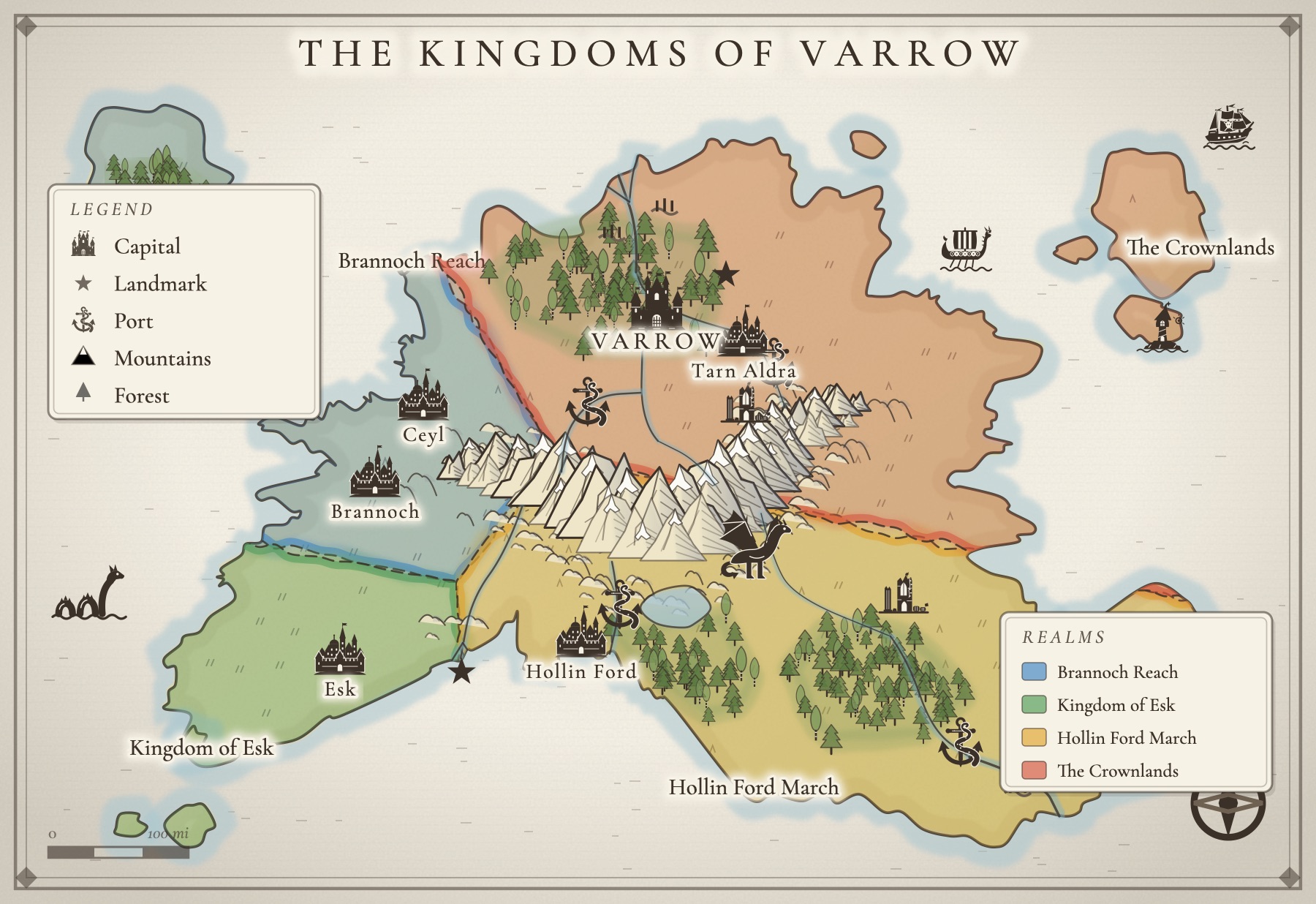
Inkling’s map maker suits the region-first approach. Start from a blank canvas or a ready-made layout (a shire, a mountain kingdom, marshlands, an archipelago and more), then place over thirty hand-drawn buildings in one ink style, from castles and villages to taverns, temples and ruins, plus a dragon for the mountain pass and a sea serpent off the coast. Paint in forest, marsh and snowfields, draw rivers and coastlines, and lay roads that route themselves around mountains and water. Realms get a wash of color and a dashed border you can redraw or split, with a key in the corner. Name everything in your own lettering. When you want the players’ copy, hide a whole layer before you download (every name, say, so the party labels the map as they learn it), or download theirs before you add the secret places. With a Map Pass, double-clicking a town opens its own linked city map. Our post on the redrawn map maker has pictures of all of it, and our guide to how to make a fantasy map walks through the basics.
Because the map lives beside your writing, you can drop it onto your Storyboard as a card, and “Places in your story” can read the places named in your session log and lay them out for you. The free map maker keeps two maps and two picture downloads. A Map Pass is $29 a year or $4 a month and keeps every map you make.
What Inkling is not: it does not make battle maps, it has no grid, no fog of war and no dice, and it is not a virtual tabletop. Use it for the world and its towns, and pair it with your VTT or a battle mat for combat.
Inkling is an independent writing app. Dungeons & Dragons and D&D are trademarks of Wizards of the Coast LLC. Inkling is not affiliated with, endorsed by, or sponsored by Wizards of the Coast.
A few questions, answered
How big should my first D&D world map be?
One region is plenty: three to five major features (a river, a forest, a mountain range, a ruin) and one to three settlements. Leave the edges blank and add to the map as the party travels.
Should my players see the DM's map?
Usually not. Keep a precise map for yourself with the secrets on it, and give the party a vaguer map of what their characters would actually know. Add to theirs as they explore.
What is the best free fantasy map maker for D&D?
It depends on how much time you want to spend. Azgaar's generator is free and builds an entire world at once. Inkarnate has a free tier with lots of art. Inkling's map maker is free to start, keeps two maps and gives you two picture downloads, and sits next to your campaign notes.
Can I make battle maps in Inkling?
No. Inkling makes world, region and city maps, not battle maps. It has no grid and no fog of war and is not a virtual tabletop, so pair it with your VTT or a battle mat for combat.
Can I turn a town on my world map into a city map?
Yes, with a Map Pass ($29 a year or $4 a month). Double-click a town on your world map and it opens its own linked city map, already named.
All of it. In one place.
This isn't five apps stitched together. Your storyboard, your cast, your maps, your covers, and the story itself all live on one desk, right beside the words. Nothing to sync between tools. No five separate subscriptions. Just everything a writer needs, finally in the same place.