How to make a town map for your campaign in 20 minutes
Your party is about to spend three sessions in one town, and somebody is going to ask how far the temple is from the tavern. You do not need a weekend of cartography. You need twenty minutes, five places, and a copy for the players. Here is the routine.
We have both spent an evening drawing a town, street by street, only to watch the party visit two buildings and leave. Now we do it the other way around: decide what the town is for, place the few things that matter, and let the rest of the streets stay streets. This is the routine, with a clock on it.
What is a town map actually for?
A town map is not a battle map. Nobody is counting squares. It is for three things:
- Orientation. Where is the temple from here? Is the smithy on the way to the gate? Players plan better when they can see the shape of the place.
- Hooks. Every named place on a map is a question. “What’s the Drowned Bell?” is how half our sessions start.
- A shared picture. When everyone has seen the same map, the town stops being five different towns in five different heads.
The Angry GM makes a useful distinction in his piece on a simple campaign region: the DM’s map is how the world really is, and the players’ map is how it looks to them, vaguer and less complete. That is true of towns too, and it is why the last step below is a player copy.
How much town do you need?
Less than you think. Sly Flourish’s spiral campaign building starts the whole campaign from one starting town and builds outward, with a small handful of locations and NPCs to begin with. We use the same idea for the map: five places the party will actually visit, and everything else stays unnamed until play gives it a reason to exist.
Our five, almost every time:
- The tavern, for gossip, rooms and trouble.
- The smithy, for gear, repairs and someone who knows who bought what.
- The temple, for healing, faith and whatever the faithful are hiding.
- The market, for everything else, and for the crowd.
- The keep, for whoever is in charge, and whatever they want from the party.
How to make a town map in 20 minutes, step by step
Here is the routine in Inkling’s map maker. Set a timer; it really does fit.
Minutes 0 to 3: start from a real street plan
Hand-drawn streets tend to come out too tidy or too random. Real towns grew around rivers, hills and old walls, and it shows. Inkling’s city maps start from the real street plans of twelve cities (Prague, Amsterdam, Lisbon, Edinburgh, Venice, Marrakesh, Kyoto and more) with every name stripped off, so the streets feel lived in and the town is entirely yours. Pick by feel: a river town, a harbor on the hills, a canal city, a walled maze. Four of the twelve are free to build on.
Minutes 3 to 8: place the five
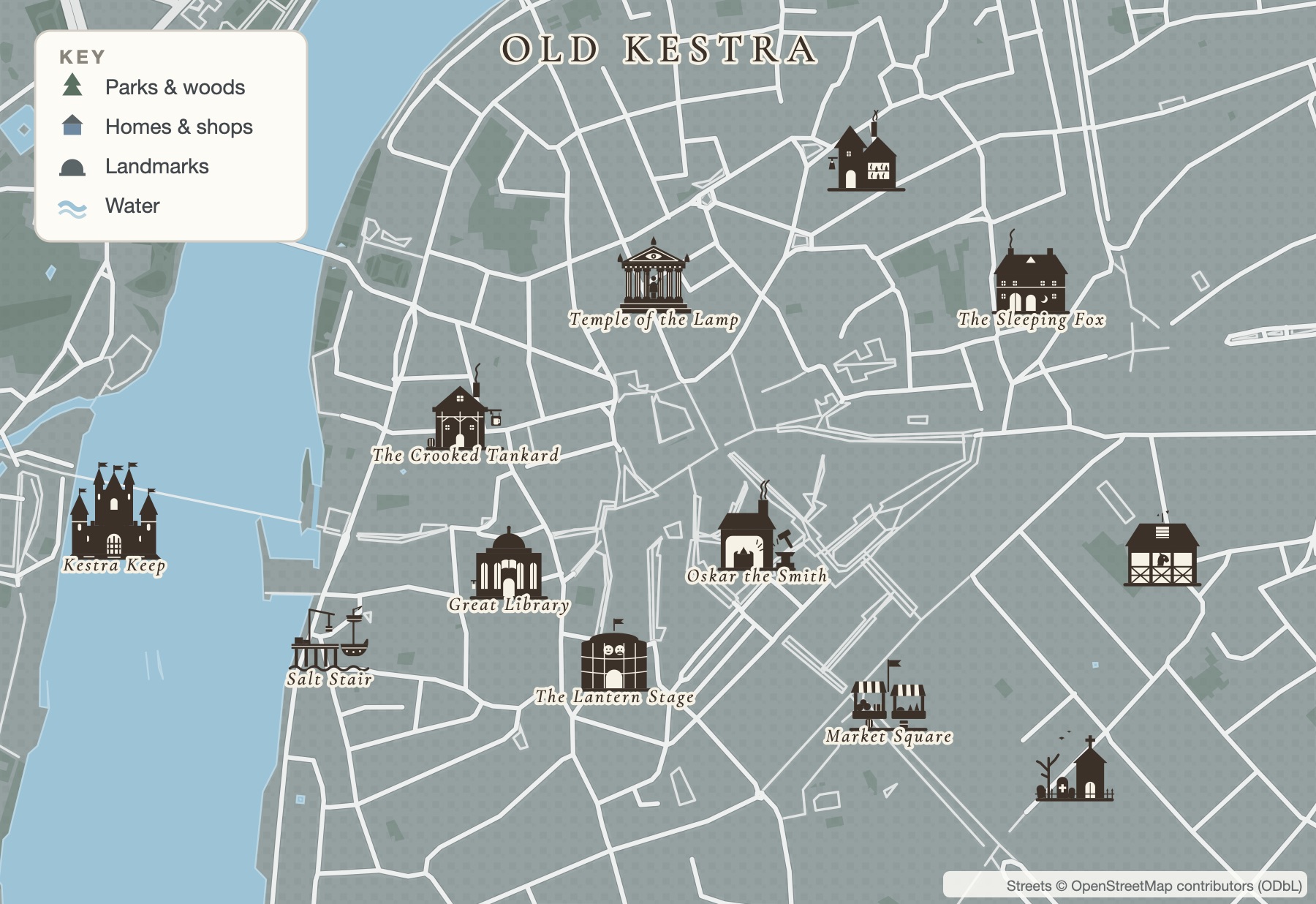
Stamp in the tavern, the smithy, the temple, the market and the keep. Every building is drawn in the same bold ink style, so the map looks like one place, not a clip-art collection. Put things where they would grow:
- The keep on the high ground, or where it can watch the river crossing.
- The market where the big roads meet.
- The smithy near the gate, where travelers and their horses come in.
- The temple on its own square, a little apart from the noise.
- The tavern close enough to the market to hear everything.
Minutes 8 to 12: name them
Names do more work than drawings. Give the town a name, then each of the five, then one street and the river if there is one. A trick for taverns and shops: an adjective and an object, or an object and an animal (the Drowned Bell, the Tin Heron). For people, keep a short list of names ready and cross them off as you use them, which also saves you at the table when a player asks the smith’s name.
Minutes 12 to 17: one rumor per place
This is the step that turns a map into a campaign. For each of the five places, write one rumor the party could hear there. Some are true, some are half true, and at least one should point at another place on the map. Keep the rumors in your notes, not on the map: the map holds names, your notes hold the secrets. (Our session notes template has a spot for which rumors the party has heard.)
Minutes 17 to 20: make the player copy
Download your players’ copy first, showing only what their characters would know. Then add anything secret (the smugglers’ cellar, the sealed crypt under the temple) and download your own copy. If you want players to fill in names as they learn them, hide a layer before you download: the Names layer, say, for a blank copy they can write on. The free map maker gives you two downloads, which is exactly one for them and one for you.
A worked example: Harrowmere
Here is a town we made with this routine, on the river-town street plan. All of it is invented for our own table.
- The Drowned Bell (tavern). Rumor: the bell that gave it its name still rings under the river on foggy nights. (True. Somebody rings it.)
- Mother Ketch’s forge (smithy). Rumor: Ketch has been shoeing horses for riders who only come at night, and they pay in old coin.
- The Temple of the Quiet Lamp. Rumor: a novice was sent away last month, and the abbess has not left the temple since.
- The Wet Market. Rumor: the fish sellers stopped going upriver. Nobody will say why.
- Harrow Keep. Rumor: Lord Ansel is hiring outsiders for a job his own guards refused.
Five places, five rumors, and three of them already point at each other. That is enough town for several sessions. If one of your players brought a character tied to that temple, our session zero questionnaire shows how to turn that into hooks.
What if I just want a random town right now?
Then use Watabou. The Medieval Fantasy City Generator by Oleg Dolya is free, runs in your browser, and makes a convincing walled town in one click, with PNG and SVG exports. Plenty of DMs use it every week, and it is genuinely good. If you need a town in the next thirty seconds and do not mind the look, it is a fine choice.
Where Inkling is different: you start from real streets instead of generated ones, the buildings and lettering match your world map in the same ink style, you name everything in your own words, and with a Map Pass you can double-click a town on your world map to open its own linked city map. If you have not made that world map yet, our world map that grows every session and our guide on how to make a fantasy map start there.
How Inkling fits
Inkling is a writing app with a map maker built in, made by two writers who play. For town maps it gives you real street plans, over thirty hand-drawn buildings in one style, three map styles (Inkling Wash and Copperplate are free, Gilded Night comes with a Map Pass), your own lettering, and layers you can hide before you download. Drop the map onto a Storyboard next to a card for each rumor, and the whole town is on one page. You can see everything new in the map maker too.
What Inkling is not: it is not a virtual tabletop, and it does not make battle maps. There are no grids, no fog of war and no dice. When the party picks a fight in the Drowned Bell, use your VTT or a battle mat for the fight, and use the town map for everything around it.
The map maker is free to start: keep two maps and download two pictures (they carry a small Inkling credit in the corner), no card. A Map Pass is $29 a year or $4 a month and keeps every map, opens all twelve cities and gives you print-size and SVG files with no credit.
Inkling is an independent writing app. Dungeons & Dragons and D&D are trademarks of Wizards of the Coast LLC. Inkling is not affiliated with, endorsed by, or sponsored by Wizards of the Coast.
A few questions, answered
Is there a free D&D town map maker?
Yes, a few. Watabou's Medieval Fantasy City Generator is free and makes a whole walled town in one click. Inkling's map maker is free to start too: it keeps two maps and gives you two picture downloads, and four of its twelve real-street city layouts are free to build on. A Map Pass is $29 a year or $4 a month for all twelve, every style and print-size files.
What should a town map include?
Only the places the party will actually visit, usually about five: somewhere to drink and hear gossip, somewhere to buy and repair gear, somewhere holy, a market, and whoever is in charge. Add the roads between them, water if there is any, and the gates. Leave the rest as streets you can fill in later.
What is the difference between a town map and a battle map?
A town map shows where things are in relation to each other, so the party can plan and travel. A battle map is a close-up grid for a fight, where every square matters. Most campaigns want both, from different tools. Inkling makes town and world maps, not battle maps.
Should players see the same map as the DM?
Usually not. Keep a DM copy with the secret places, and give the players a copy that shows only what their characters would know. The Angry GM makes the same point about regional maps: the DM's map is how the world is, and the players' map is how it looks to them.
How big should a starting town be?
Smaller than you think. A town the party can walk across in a scene, with five places that matter and room to add more, is plenty for the first few sessions. You can always add a district when the story needs one.
All of it. In one place.
This isn't five apps stitched together. Your storyboard, your cast, your maps, your covers, and the story itself all live on one desk, right beside the words. Nothing to sync between tools. No five separate subscriptions. Just everything a writer needs, finally in the same place.