One page and a map: a player primer for your homebrew world
Your players will not read forty pages of lore. They will read one good page, and they will stare at a map for as long as you let them. Here is how to make both, with a one-page template you can copy tonight.
We have both handed players a lovingly written twenty-page world document and watched it go unread. We are not alone. In an EN World thread on pre-campaign handouts, DMs report the same thing again and again: long primers get skimmed, short and good-looking ones get read, and a personal line for each player lands best of all. Sly Flourish’s one-page campaign guide boils it down to a single sheet, and that is the format we use. Our version: one page on the front, a map on the back.
What goes in a one-page campaign primer?
- The pitch. One or two sentences on what is wrong in the world and who the PCs are to it.
- Six truths. Six things about the world that make it different from every other fantasy world, a structure borrowed from the Lazy DM.
- Factions. Up to three, each with a symbol, a leader and a want.
- Character creation notes. What fits, what does not, and how characters tie to the starting town.
- Safety tools. Lines and veils, and how anyone can pause the game.
- The practical bits. When you play, where, and the date of session zero.
What stays off the page: the BBEG’s plan, secrets and clues, history from before anyone alive remembers, the full list of gods, and anything the party is supposed to discover. Gnome Stew’s tips for a players’ guide make the same point: write for what the players need, not for everything you know.
How to write the pitch
The pitch tells players what they will be doing, so they can make characters who want to do it. Here is one for a made-up campaign we will use through this post:
The Ember Reach. The last lighthouse on the Ember Reach has gone dark, and the ships have stopped coming. You are the salvagers, smugglers and oath-breakers the harbor town of Gullsend hires when no one else will go.
Notice it names a starting town. Build small: start with one town and the few places around it, then spiral outward as the party explores. Sly Flourish calls this spiral campaign development, and it saves you from writing a continent nobody visits.
Six truths that give players something to do
A good truth is short, a little surprising, and hands a player a reason to act. For the Ember Reach:
- The sea is rising a hand’s width every year, and the old towns are going under.
- Lighthouses are holy. Their keepers answer to no crown.
- Magic is sung. A singer who loses their voice loses their power.
- The dead are buried at sea, and sometimes the sea sends them back.
- Gullsend is free, for now, because two neighboring crowns both want it.
- No ship has crossed the Grey Shelf and returned in forty years.
Factions: three is plenty
Give each faction a symbol players can draw on a note, a leader they might meet, and a want that pulls against the others:
- The Keepers of the Lamp (a white flame). Led by Warden Osric Hale. Want the light relit, whatever it costs.
- The Tidewright Guild (a knotted rope). Led by Madam Ysolde Crane. Want salvage rights to the drowned towns.
- The Hollow Choir (a closed mouth). Led by no one knows. Want the sea to finish rising.
That third one hints at the villain without explaining anything. The players will ask. Let them.
Character creation notes and safety tools
Keep character notes practical: the kinds of characters that suit the campaign, anything that will not fit, and one tie to the starting town (“name one person in Gullsend you owe”). Ask for a short backstory with gaps you can fill. Our backstory template and session zero questionnaire pick up from here.
For safety tools, a few lines are enough. Lines are content that will not appear at all. Veils are things that can happen but stay off screen. Say how anyone can pause the game with no reason needed, and invite players to add lines and veils privately. If you want more questions for session zero, Troy Press has a good list.
A one-page campaign guide template you can copy
Fill in the brackets, cut anything you do not need, and keep it to one page. If it spills over, the six truths are too long.
[CAMPAIGN NAME]
A campaign for [number] players. Session zero: [date]. We play [when, where].

THE PITCH
[One or two sentences: what is wrong in the world, and who the PCs are to it.]

SIX TRUTHS
1. [Something about the land or the danger]
2. [Something about power: who rules, who pays]
3. [Something about magic or faith]
4. [Something about the dead, the gods, or the old world]
5. [Something about the starting town]
6. [A mystery nobody has answered]

FACTIONS
- [Name] ([symbol]) Led by [leader]. Wants [goal].
- [Name] ([symbol]) Led by [leader]. Wants [goal].
- [Name] ([symbol]) Led by [unknown?]. Wants [goal].

MAKING YOUR CHARACTER
- Fits well: [kinds of characters that suit this campaign]
- Please avoid: [anything that will not fit]
- Your tie: name one person in [starting town] you owe, and one you trust.
- Backstory: a few sentences is plenty. Leave gaps for me to fill.

TABLE AND SAFETY
- Lines (never at this table): [list]
- Veils (happens off screen): [list]
- Pause anytime: [your check-in tool]. No reason needed.
- We check in with stars and wishes at the end of each arc.

On the back: a map of [region]. It shows what your characters know. It is not the whole world.
Why put a map on the back?
A map makes names stick. Players who have seen Gullsend, the dark lighthouse and the Grey Shelf on paper will say those names at the table, and they will point at the edges and ask what is out there. That question is a hook you did not have to write.
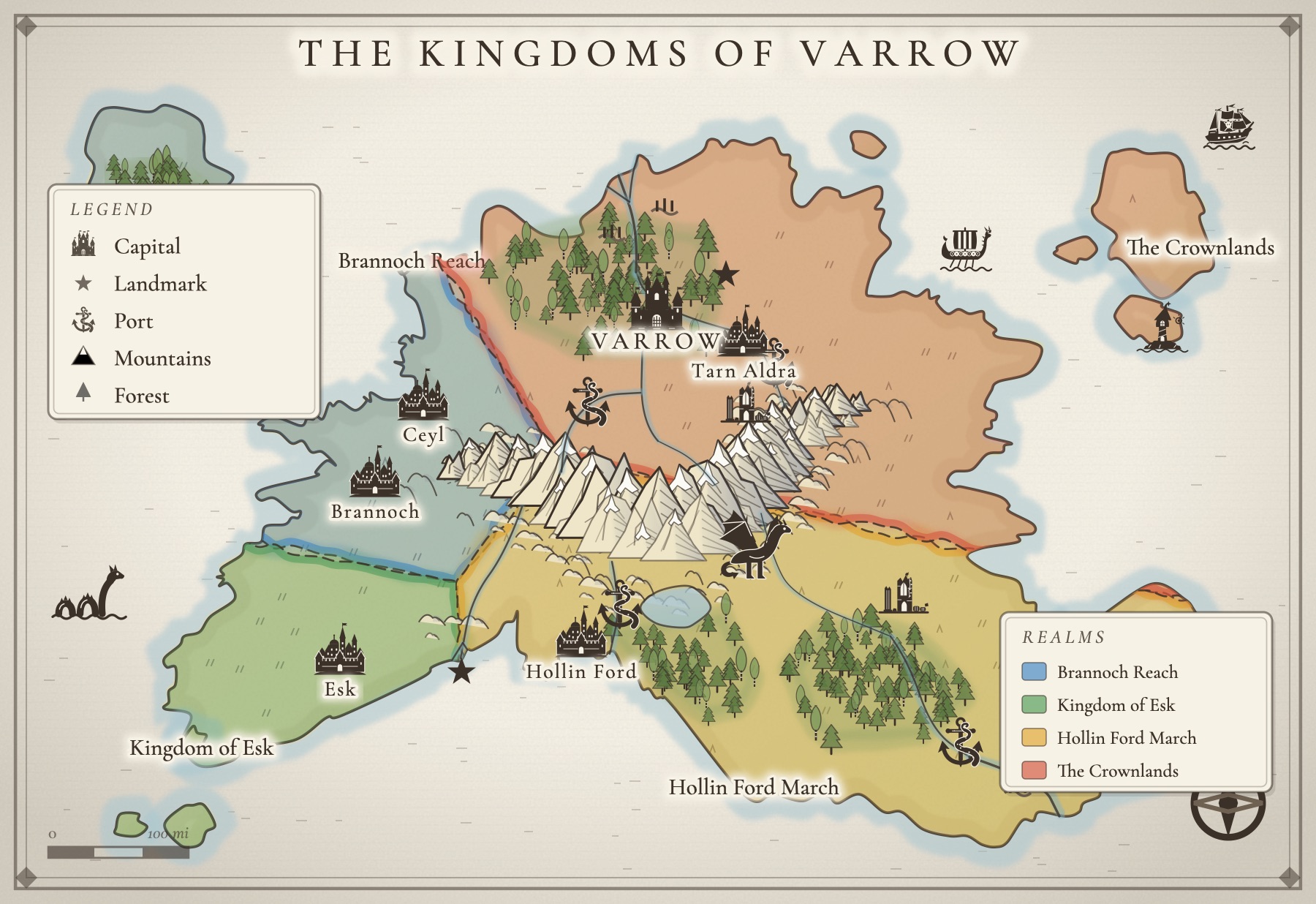
The Angry GM’s advice on a simple campaign region fits a primer perfectly: keep two maps, your precise one with the secrets and a vaguer one for the players, and start with a single region with a handful of major features and one to three settlements.
How to make a player-safe map
- Draw the region around the starting town, not the continent. For us: Gullsend, the coast, the lighthouse, the Grey Shelf.
- Put in the features the primer mentions, and not many more. Three to five is enough.
- Name only what the characters would know. Locals know the lighthouse. Nobody knows where the Choir meets.
- Download the player copy before you add the secrets. Then add the hidden sea cave, the real wreck and the Choir’s shrine to your own version.
- Or hide a layer before you download. Hiding every name, for example, gives players a blank map they can label as they learn.
- Leave the edges empty. That is where the campaign grows. Our post on a world map that grows every session picks up from here.
In Inkling’s map maker you can start from a ready-made layout (an archipelago, a shire, a frozen north) or a blank canvas, stamp in a lighthouse, ruins and docks from a set of over thirty hand-drawn buildings, and color in realms with dashed borders for the two crowns that want Gullsend. Name everything yourself; there is a legend, a scale bar and a compass. Marks sit in a handful of layers (land, terrain, roads and rivers, places, names), and any of them can be hidden before you download. The free map maker keeps two maps and gives you two picture downloads, which is plenty for a primer. If you need a map of Gullsend itself, see how to make a town map in 20 minutes, or our longer guide on how to make a fantasy map.
How do you get players to actually read it?
- Send it a week before session zero, not the night before.
- Read the pitch aloud at session zero, then ask each player which truth they like best.
- Print it. A sheet of paper on the table gets looked at all night. A link gets forgotten.
- Add one personal line per player. A rumor only their character has heard. It is the part they will remember.
Share it by link, print it for the table
We write our primers as a story in Inkling and send the party a private, read-only link. There is nothing for them to sign up for, and they can leave notes in the margins, which is a lovely way to collect questions before session zero. When the campaign grows past one page (a few handouts, a faction sheet, a recap or two), “Print your story” turns it into a booklet PDF you can print at home.
How Inkling fits
Inkling is a writing app made by two writers who play. For a primer it gives you the map maker for the player-safe map, a story you can share by private link, and “Print your story” when you want paper. As the world grows you can keep factions and places on a Storyboard and NPCs on character cards, and if you want the bigger picture, our guide on how to create a fantasy world is a good next read.
What Inkling is not: it is not a VTT. There are no dice, no stat blocks, no grids and no battle maps. Run the game in your VTT of choice or on paper sheets, and use Inkling for the world around it: the page, the map, and the story that grows out of both.
Inkling is an independent writing app. Dungeons & Dragons and D&D are trademarks of Wizards of the Coast LLC. Inkling is not affiliated with, endorsed by, or sponsored by Wizards of the Coast.
A few questions, answered
What is a campaign primer?
A short player handout for a homebrew campaign, given out before session zero. It tells players what the campaign is about, what is true about the world, who holds power, what kind of characters fit, and how the table handles safety. The best ones fit on one page.
How long should a player handout for a homebrew campaign be?
One page, with a map on the back. Long primers tend to go unread. Put only what the characters would know and what the players need to make characters, and let the rest come out in play.
What should I leave out of a player primer?
The villain's plan, secrets and clues, deep history, full pantheons and anything the party is meant to discover. If a player does not need it to make a character or to understand the first session, it belongs in your notes.
Should players get the same map as the DM?
No. Keep a precise map for yourself with every secret on it, and give players a simpler one that shows only what their characters know. Download the player copy before you add the secret places, or hide a whole layer (every name, say) before you download so players label the map as they learn.
What are lines and veils?
A safety tool for the table. Lines are content that will not appear in the game at all. Veils are things that can happen but stay off screen, with no detail. List both on the primer and invite players to add their own privately.
All of it. In one place.
This isn't five apps stitched together. Your storyboard, your cast, your maps, your covers, and the story itself all live on one desk, right beside the words. Nothing to sync between tools. No five separate subscriptions. Just everything a writer needs, finally in the same place.