Map before you write: a Novel November prep plan
Novel November starts in three weeks. You can spend them worrying about chapter one, or you can spend four evenings building the world your story moves through, so that on November 1 you sit down knowing where your characters are, where they are going, and what is standing in the way. Here is the plan.
Every November, the writers who reach the end are rarely the ones with the most talent. They are the ones who did not have to stop and decide things. Who is the villain? Where does the second act happen? How far is the city from the coast? Every question you answer in October is a question that cannot stall you in week two.
A map answers a surprising number of those questions at once. It is also the most fun kind of preparation, which matters: October prep should make you want to start, not make you tired before you begin. So here is a plan built around one map and four evenings, with room left over for an outline and a life.
Why the map comes first
Drafting fast means making hundreds of small decisions without breaking stride. Which way does the road out of town go? How many days to the border? Is the harbor north or south of the castle? Without a map you answer these on the fly, and on day nineteen you discover the journey that took three days in chapter four now takes a week. With a map you glance and keep typing.
The bigger reason is that maps generate story. Put a mountain range on the page and you have a barrier, a border and a pass someone controls. Put a river through a valley and you have trade, a ford, a town at the crossing and a reason to fight over it. You will find plot on the map that you would not have found in a blank document.
Evening one: sketch the world in an hour
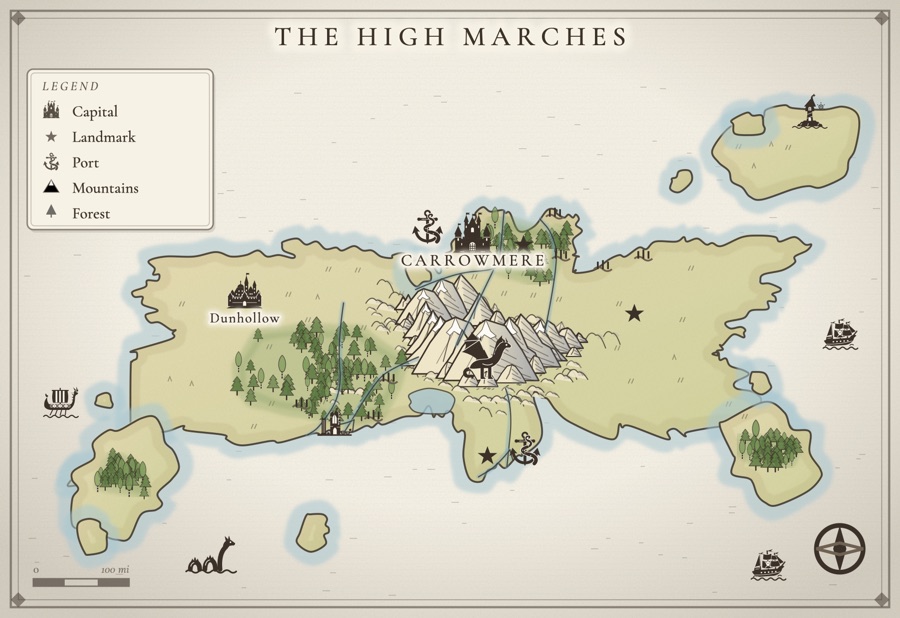
Not the whole continent. Just the part your story travels. The fastest way to do that is to start from something rather than nothing:
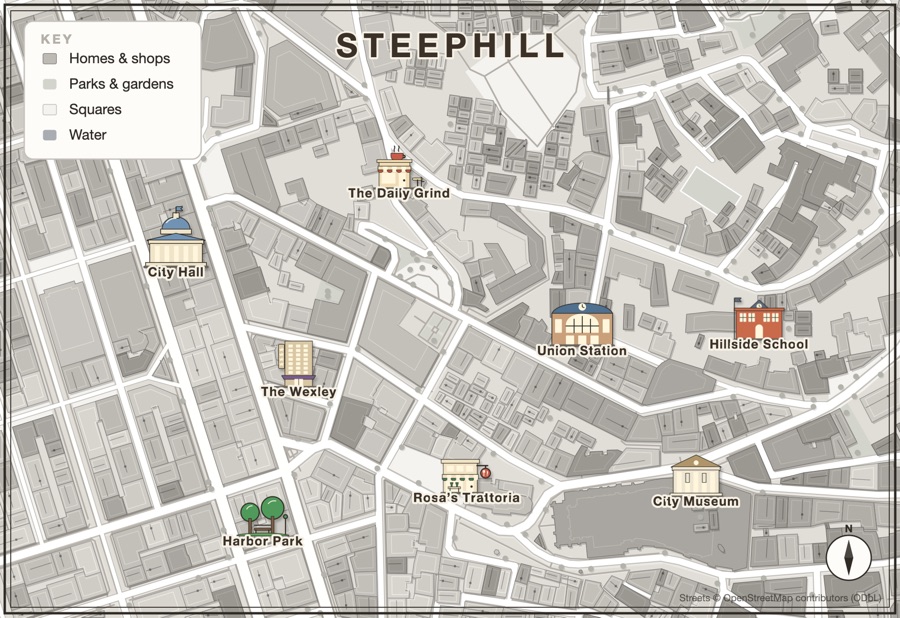
- Pick a starting shape. In Inkling's map maker, choose a ready-made layout (an island, a mountain kingdom, warring kingdoms already split into realms, a frozen north) or describe the world in a sentence and let the generator draw it. If your story is set in a city, start from one of the city layouts built on real street plans instead.
- Check the bones. Is there high ground? Do rivers run from it down to the sea? Is there a coast, a forest, somewhere dry? If you want the rules for making this believable, our guide to fantasy map geography covers them in ten minutes.
- Name the world and stop. One name for the land, maybe one for the sea. Resist naming everything tonight. Names come in evening two, and only for places that earn them.
Set a timer for an hour. A rough map you finish is worth more than a beautiful one you are still fiddling with on Halloween.
Pick a stamp, tap the realm to drop it, drag it into place, double-tap to name it.
Evening two: mark the places your plot visits
Now walk your story across the map. Most novels visit somewhere between five and eight places that matter. Stamp them in and name them:
- Where it starts. Home, the ordinary world, the place your character will have to leave or defend.
- Where it goes wrong. The inciting incident needs a location, and it is often a little way from home.
- The places in the middle. Two or three stops where the story turns: a city where your character finds help, a fortress where they are captured, a crossing where they lose something.
- Where it ends. The climax needs a place with weight. Put it somewhere the reader will have heard of long before the characters arrive.
- Where the opposition lives. Even if your characters never go there, you should know where the threat is coming from.
Then draw the route between them. Look at how long each leg is. If the journey in the middle of the book is the longest one on the map, that is where your sagging middle will be, unless you give the road something to do.
Evening three: find the conflict on the map
This is the evening that pays for the other three. Look at your map and ask what each feature means to the people who live there:
- Borders. Carve the land into realms with colored borders. Who rules each one? Which border is disputed? A border that follows a river is a border someone wants to move.
- Routes. Draw the roads between towns. Where do they all pass through one place: a bridge, a pass, a single harbor? Whoever holds that place holds power, and your characters will have to get past them.
- Resources. Where is the good farmland, the mine, the only fresh water in the dry country? Put it near a border and you have a war waiting to happen.
- Distance. Who is far from the capital and resents it? Who lives close enough to be watched?
Write each conflict you find as a single line in your notes. You will not use all of them. But in week three of November, when you need something to go wrong, you will have a list of things the world already wants to go wrong.
Evening four: turn the map into a story, and set the goal
By the last week of October you have a map, a route and a list of conflicts. Now move it all onto your writing desk. In Inkling, open your kept map and press Write a story here in the top bar. It starts a new story named after your map, with every place you named on the map listed in the story's notes and a few opening questions to try, and the map moves onto the story so it is right there in its Maps panel while you write. Add your one-page outline beside it on the storyboard: how it opens, how it ends, and the four or five turns in between.
Then set your goal before November arrives, so the first morning is only about writing. Use the free pace planner on our November novel challenge page: pick your target and your days off, and it gives you a daily number and a printable tracker, or carries the whole thing into Inkling as a goal on your desk. The goal shows today's number, your running total and whether you are on pace, and if a day slips, the daily target adjusts to what is actually left instead of piling the missed words onto tomorrow.
What not to do in October
- Do not map the whole world. Map what the story visits. The far corners can stay blank until a scene sends someone there.
- Do not name every village. Name the places that matter to the plot. Blank space reads as depth.
- Do not write chapter one. Save the momentum for November 1. Notes, outlines and maps are fair game; prose is not.
- Do not let the map become the project. If you are still adjusting coastlines on October 30, stop. A good-enough map plus a finished draft beats a perfect map and a blank page.
November 1
Open the story. The map is in its Maps panel, the places are in the notes, the outline is on the board, and the goal is waiting on your desk. Read your first line of notes, look at where your character is standing on the map, and start walking them toward the first place that goes wrong.
For the month itself, our guide on how to write a novel in 30 days has the math, a shape for each week and what to do on the day you fall behind. If you want the deeper version of the map work, see how to make a fantasy map, or how to make a city map for your novel if your story lives in streets instead of kingdoms.
Inkling is free to start for 14 days, with no card: the writing desk, the storyboard, character cards and the map maker, keeping two maps and downloading two. A Map Pass is $29 a year for every map, and Plus, $9 a month, opens the whole writing desk.
A few questions, answered
What should I do in October to prepare for Novel November?
Four things: sketch a rough map of where your story happens, mark the places the plot visits, write a one-page outline of how it opens and ends, and set your word count goal with your days off already chosen. Do not write chapter one yet. October is for the plan; November is for the words.
Do I need a map to write a novel in a month?
Not every story needs one, but any story that travels does. A rough map stops you from inventing geography at eleven at night, keeps journeys and distances consistent across thirty days of fast drafting, and often gives you plot: a border to cross, a route to control, a river nobody wants to ford.
How long does it take to make a world map for a novel?
One evening for a useful one. Start from a ready-made layout instead of a blank page, place the five to eight locations your plot actually visits, and name only those. You can refine it in December. A map that is good enough to draft with is all you need by November 1.
Is NaNoWriMo still happening?
The nonprofit that ran National Novel Writing Month closed in 2025, but the tradition of drafting a novel in November carries on. Writers call it Novel November, or just the November challenge, and you can take part on your own or with friends. Inkling's November novel challenge page has a free pace planner and a printable tracker.
How many words a day is Novel November?
The classic target is 50,000 words in 30 days, which is 1,667 words a day with no days off, or about 1,925 a day with Sundays off. Any number you will actually hit is better than one you abandon on day nine.