Burnt out and reading romantasy every night? Try writing one, ten minutes at a time
The day takes everything. The meetings, the messages, the people who need you, the list that never ends. Then, finally, you get into bed with a romantasy and for an hour you are somewhere with courts and bargains and someone who would burn a kingdom down for the person they love. If that is your evening, this is not a post telling you to be more productive. It is an invitation to play: ten minutes, now and then, writing the scene you would most like to read tonight. No quota, no finish line, and nobody ever has to see it.
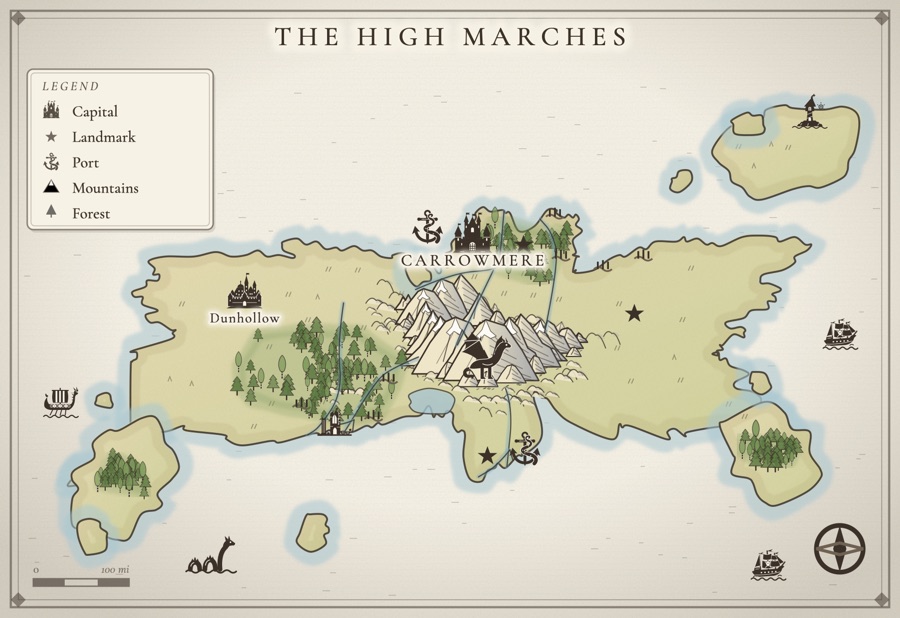
Pick a stamp, tap the realm to drop it, drag it into place, double-tap to name it.
First: reading to escape is allowed
Let us get this out of the way. You do not need to justify reading romantasy every night. Escape is a real need, and a book that takes you somewhere else for an hour is doing exactly what it should. Nobody is asking you to turn your comfort into self-improvement.
This post is for a slightly different feeling: the one where you finish a chapter and think, “I wish there were a scene where she finally says it,” or “I would read a whole book about the cartographer in chapter three.” That little itch is the beginning of writing. You already know what you love. You might enjoy, sometimes, making a bit of it yourself.
Why making can feel different from reading
Reading lets you rest inside someone else's imagination. Making something puts you in charge of one, and for many people that feels different in a good way, even in very small doses. There is some research that points in this direction, with sensible limits. In a daily diary study of 658 young adults, published in the Journal of Positive Psychology, Tamlin Conner, Colin DeYoung and Paul Silvia found that on days after people spent more time than usual on creative activity, they reported more positive energy and a greater sense of flourishing. It is one study of young adults over thirteen days, not a prescription, but it fits what many people notice: a little making tends to feel good the next day.
You will also hear about expressive writing, so here is what it is, accurately. In the 1980s the psychologist James Pennebaker began studying what happens when people write about their deepest thoughts and feelings about an emotional experience, typically for 15 to 20 minutes on a few consecutive days. Some studies found modest benefits. A 2023 paper in Frontiers in Psychology reviews the field and is honest about it: the effects have been hard to pin down, some meta-analyses found small to medium benefits, and others found none. That research is about writing directly about your own emotional experiences, not about writing fiction, and it is not a burnout treatment. We mention it so you know what it does and does not say, not to promise that a fae romance will fix your week.
What we can say is simpler: writing a story you love can be fun, and fun on a draining day is worth something on its own.
If you want a challenge, that is a different post
We just published an 11-week plan for drafting 40,000 words of your own fae story before the next big romantasy release. Some people love a target and a finish line, and if that sounds energizing, go there. This post is the opposite. No word counts, no deadlines, no plan to publish. If structure sounds like one more thing on your list, stay here. Both are fine. Neither is the “real” way to write.
A no-pressure way to start: ten minutes
Here is the whole method:
- Set a timer for ten minutes. Ten, not sixty. You can stop when it rings, and on most nights you will want to.
- Write the scene you would want to read tonight. Not chapter one. Not the beginning of anything. The scene you would flip ahead to if it existed: the confession, the dance, the night they are snowed into a hunting lodge with one fire and too many feelings.
- It is allowed to be bad. Wrong names, no setting, dialogue with no tags, a sentence that just says “[something romantic here].” All fine. You are playing, not drafting.
- Nobody sees it. Not a friend, not a writing group, not the internet. Knowing that no one will ever read it is what makes it safe to write the thing you actually want.
That is it. If you want more ideas for fitting writing around a demanding job, writing as a creative outlet after work is a good companion to this, and too tired to write after work covers the evenings when even ten minutes feels like a lot.
A ten-minute escape prompt card
Copy this into your notes. On a night when you feel like playing, pick one line and write for ten minutes. All of these are invented starting points, so make them yours.
TEN-MINUTE ESCAPE PROMPTS
Pick one. Set a timer. Stop when it rings.

1. Two rivals are forced to share the last room at an inn
   on the edge of a cursed forest. Write the conversation
   after the candle goes out.

2. A palace gardener is asked to grow a flower that only
   blooms for someone in love. It blooms in her hands.

3. The queen's champion has to teach his enemy to dance
   before the treaty ball. Start at the first misstep.

4. A mortal bargains with a fae lord for one year of
   safety. Write the night the year is up.

5. Two exiles meet at a frozen border crossing. One of
   them is lying about who she is.

6. A mapmaker discovers the road on her map leads to a
   house that is not supposed to exist. Someone is home.

7. Write the letter one lead would never send.

8. A masked stranger saves her at a festival, then asks
   for something strange in return.

9. Two people who used to love each other are assigned
   to guard the same door all night.

10. Write the moment just after a first kiss, from the
    point of view of the one who did not expect it.

Rules: it can be bad. It can stop mid-sentence.
Nobody has to see it.
If you want to understand why some of these situations feel so good to read, our guide to romantasy tropes walks through the favorites and how writers make them their own.
Nights with no words left
Some evenings, even a sentence is too much. That does not have to mean nothing. There are ways to play with a story that use your imagination without asking for prose:
- Build a court on a map. Drop a castle on a cliff, a town by a river, a ruined temple in the marsh. Carve the land into realms with soft colour and dashed borders, and give each one a name. Our guides on designing fae courts and mapping a fae realm are full of ideas if you want them, and entirely skippable if you do not.
- Fill in a character card. What does your love interest want? What wound are they hiding? What lie do they believe about themselves? Answering three questions about an imaginary person is a lovely, low-effort way to end a day.
- Collect names. Keep a list of names for people, places, taverns and kingdoms. Our fantasy name generator has tabs for towns, kingdoms and realms, characters and taverns if you want a nudge.
- Drag scene cards around. Write three or four one-line ideas on cards (“the bargain,” “the ball,” “she finds the letter”) and shuffle them into an order. It is daydreaming with handles.
None of that is homework. If one of them sounds like fun tonight, do it. If none do, read your book.
A gentle rhythm: one scene a week
If you find you like this, a loose rhythm can help it stick without turning it into a job. One scene a week is plenty. Pick an evening that is usually a little lighter (for a lot of people that is Friday or Sunday), and keep it as the night you might play. Some weeks you will write two scenes. Some weeks you will build a map instead. Some weeks you will skip it entirely. The rhythm is there to remind you, not to judge you.
Over a few months, those scenes add up to something. Maybe a story starts to form around a pair you keep returning to. If that happens and you want a bit more shape, how to write romantasy covers the craft, and the 20-minute writing plan and writing a novel with a full-time job are written for people with very full days. But that is optional, and a drawer full of scenes nobody will ever read is a perfectly good outcome.
When it turns into another chore
Watch for these signs:
- You feel a small dread when your writing night comes around.
- You feel guilty about the weeks you did not write.
- You start counting words, comparing yourself to people online, or thinking about what an agent would say.
- You are writing because you think you should, not because you want to.
If any of that is happening, change something. Drop the goal, if you set one. Skip a week, or a month. Go back to the parts that were fun: the one scene you were dying to write, the map, the names. Write something deliberately silly. The point was always play, and you are allowed to protect it from your own ambition.
And one more thing, said plainly and kindly: if your burnout feels severe, or it is affecting your sleep, your health or your daily life, please talk to a doctor or a mental health professional. The World Health Organization describes burnout as coming from chronic workplace stress that has not been successfully managed, and that deserves real support. A hobby is a good thing to have alongside that, never instead of it.
Where Inkling fits, honestly
Inkling is a writing app with a few playful tools beside the page. For a tired evening, that means:
- A private place to write. Your scenes live as chapters you can name and move up and down, with a private Notes pad beside each one that never goes into your exports. Goals are optional; you never have to set one.
- The map maker for wordless nights. Stamp castles, towns, temples, ruins and taverns, paint marsh and snowfields, and carve the land into named realms with soft colour and dashed borders. Try it in the demo above.
- The Character builder. Want, wound, the lie they believe, fears and trait chips, for anyone who lives in your head.
- The Storyboard. Drag scene cards around and link them with arrows, for nights when you just want to daydream an order.
- The Muse. What-ifs, twists, relationships, settings and first lines from built-in lists, including slow-burn romance, second-chance romance, gothic romance and dark fairy tale lenses. It never reads your story.
What Inkling does not have: a trope picker, a fae name generator, or a place to post fan fiction. It is a desk, not a social network. During the 14-day trial you can start 3 stories and keep 2 maps, which is plenty for a few weeks of play.
A few questions, answered
Is it okay to read romantasy just to escape?
Yes. Reading for comfort and escape is a perfectly good reason to read, and you do not owe anyone a better one. This post is not about replacing it. It is about adding, now and then, a different kind of escape: making something of your own.
Will writing cure my burnout?
No, and nobody should promise that. The World Health Organization describes burnout as the result of chronic workplace stress that has not been successfully managed, so the real fixes usually involve the work itself, rest and support. Writing for fun can be a pleasant part of an evening. If burnout is severe or affecting your health, please talk to a doctor or a mental health professional.
What if I have never written fiction before?
Then you are in the best position to play, because you have no standards to disappoint. Start with ten minutes and the scene you would most like to read tonight. It does not need to be part of a book, it does not need to be good, and it does not need to make sense to anyone but you.
Do I need to plan a whole novel first?
No. You can write single scenes for months without a plan, a title or an ending. If a story grows out of them and you want structure later, there are plenty of guides for that. For now, one scene at a time is the whole plan.
How do I stop it from becoming another chore?
Watch for the signs: dread, guilt, tracking numbers you never wanted, or writing because you think you should. When that happens, drop the goal, skip a week, and come back only to the parts that are fun. The point is play. If it stops being play, change it until it is again.
All of it. In one place.
This isn't five apps stitched together. Your storyboard, your cast, your maps, your covers, and the story itself all live on one desk, right beside the words. Nothing to sync between tools. No five separate subscriptions. Just everything a writer needs, finally in the same place.